
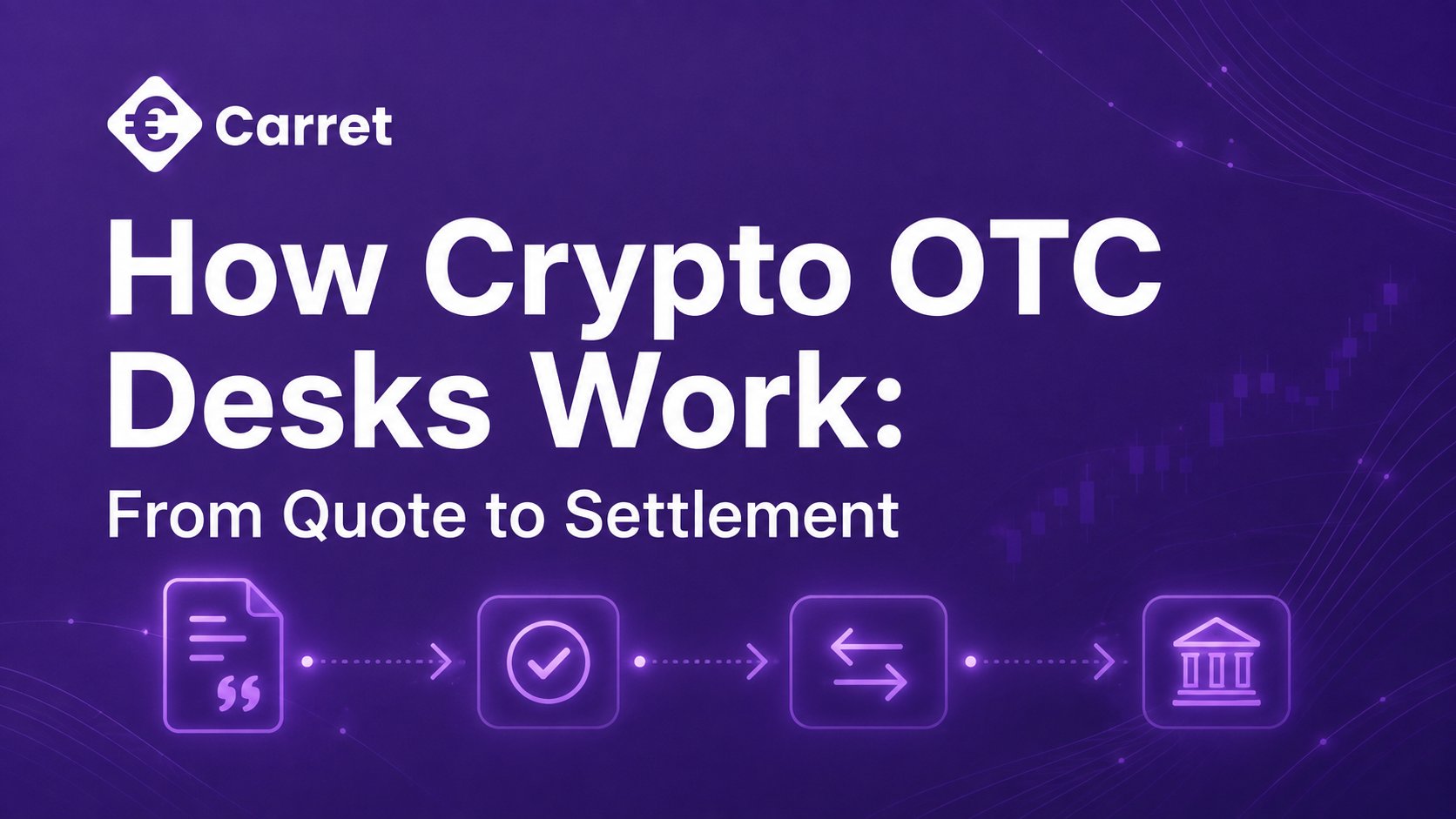
For institutional investors, businesses, and high-volume traders, executing a large cryptocurrency trade is about more than simply finding the best price. It's about minimizing market impact, accessing reliable liquidity, and ensuring a smooth settlement process.
This is where a crypto OTC (Over-the-Counter) desk comes in.
Unlike public exchanges, where trades are matched through an open order book, OTC desks facilitate transactions privately, helping clients execute large trades efficiently and with greater discretion.
In this guide, we'll walk through how a crypto OTC desk works - from requesting a quote to settling the trade.
Step 1: Request a Quote (RFQ)
Every OTC trade begins with a Request for Quote (RFQ).
The client contacts the OTC desk and shares key details about the intended trade, including:
Whether they want to buy or sell
The cryptocurrency (such as BTC, ETH, USDT, or USDC)
The trade size
Preferred settlement currency
Settlement timeline
Unlike an exchange, where prices are constantly changing on an order book, an OTC desk provides a tailored quote based on the specific transaction.
Step 2: Price Discovery
Once the request is received, the OTC desk begins sourcing liquidity.
Rather than relying on a single exchange, many OTC desks aggregate liquidity from multiple sources, including:
Exchanges
Market makers
Liquidity providers
Institutional counterparties
This broader view of the market helps the desk determine a competitive executable price, especially for larger transactions.
Step 3: Quote Confirmation
After evaluating available liquidity, the OTC desk shares a quote with the client.
The quote typically includes:
The agreed exchange rate
Trade size
Settlement details
Quote validity period
If the client accepts the quote within the specified time, the trade moves forward.
Step 4: Trade Execution
Once the quote is confirmed, the OTC desk executes the transaction.
Depending on the trade size and market conditions, execution may involve sourcing liquidity from multiple venues while presenting the client with a single agreed price.
The goal is to complete the trade efficiently while minimizing unnecessary market impact.
Step 5: Settlement
After execution, the final step is settlement.
The client transfers funds or digital assets according to the agreed terms, and the OTC desk completes the corresponding transfer.
Settlement methods vary depending on the asset, jurisdiction, and the parties involved, but the objective remains the same: a secure and efficient transfer of value.
Why Businesses Choose OTC Desks
The OTC process is designed to solve challenges that become more important as trade sizes grow.
Better Execution
Large trades require more than simply clicking "Buy" or "Sell." OTC desks focus on achieving efficient execution by sourcing liquidity and managing the transaction from start to finish.
Access to Deeper Liquidity
Because OTC desks often work with multiple liquidity providers, they can facilitate larger transactions than a single exchange order book may comfortably support.
Reduced Market Impact
Executing large orders privately helps reduce the visible impact that can occur when sizeable trades are placed directly on a public exchange.
Dedicated Support
Clients work directly with an experienced OTC team throughout the trade, providing greater clarity and support during execution and settlement.
A Typical OTC Trade Flow
A standard OTC transaction usually follows this sequence:
Client submits a trade request.
OTC desk sources liquidity.
A quote is provided.
Client accepts the quote.
The trade is executed.
Assets and funds are settled.
While the process is straightforward, each step is designed to improve execution quality and provide a more seamless trading experience for larger transactions.
Frequently Asked Questions
How long does an OTC trade take?
Execution time depends on the trade size, asset, market conditions, and settlement requirements. Once both parties agree on pricing, many trades can be completed efficiently.
Can OTC desks support different cryptocurrencies?
Yes. Most institutional OTC desks support major digital assets such as Bitcoin (BTC), Ethereum (ETH), USDT, and USDC, although supported assets vary by provider.
Is there a minimum trade size?
Many OTC providers have minimum transaction sizes, which differ from one desk to another.
Final Thoughts
Crypto OTC desks provide a structured approach to executing large digital asset transactions. By combining private execution, access to broad liquidity, and dedicated support, they help businesses and institutional investors trade more efficiently than relying solely on public exchanges.
Understanding how the OTC process works - from requesting a quote to final settlement can help organizations choose the right execution method as their trading needs grow.
Execute Large Trades with Carret
Carret’s institutional OTC desk is designed for businesses and professional investors who require reliable liquidity, efficient execution, and dedicated support. From your first quote to final settlement, our team is focused on making large digital asset transactions simple, secure, and seamless.